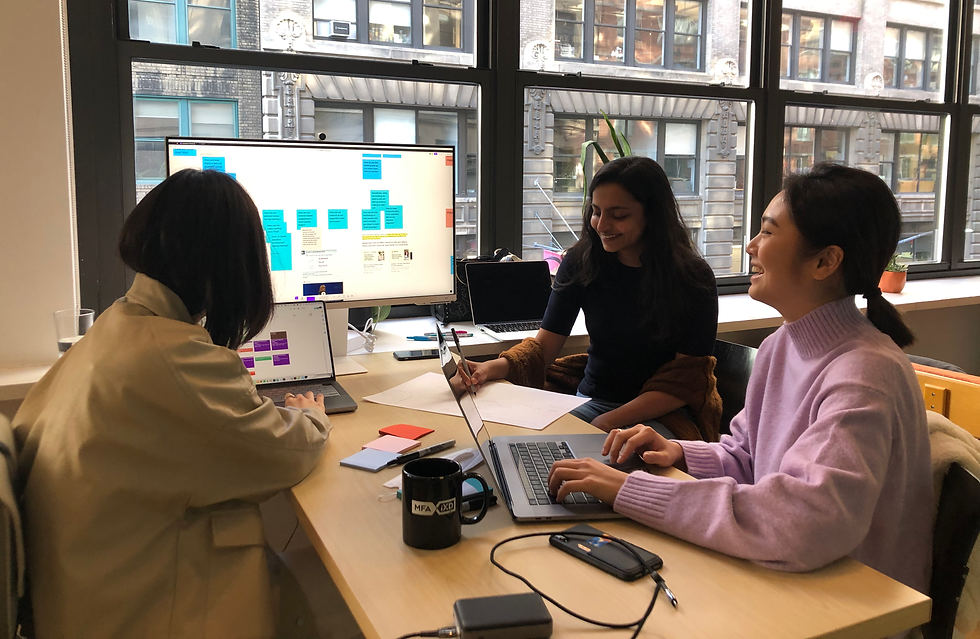
Rethinking how employees engage in remote workplaces post the pandemic.
Role
Product Designer
Outcomes
New product concept and pitch
Teammates
1 Project Sponsor, 2 Product Designers, 2 Faculty Advisors
Duration
Aug - Dec 2022
Employees needed not just better meetings, but also better connection
Context/ In 2022, as remote work became the new normal, we set out to improve online meetings. But early research revealed a deeper issue: employees weren’t struggling with how to meet—they had too many meetings and were suffering from meeting fatigue.
Problem/ Studies showed a 252% increase in meeting time, leaving employees drained, disengaged, and less productive. More concerning, we found that the real toll of remote work was emotional. Without spontaneous moments that once happened in office hallways and break rooms many employees felt isolated or even depressed, echoing findings from a 2022 Buffer report where 52% of remote workers cited "loneliness" as their biggest struggle.
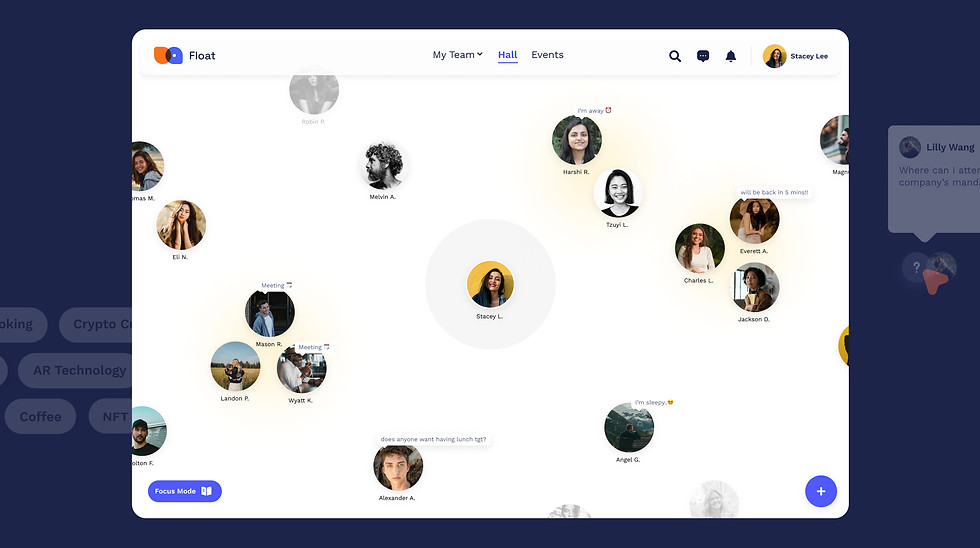
Solution/ The insight led us to pivot: instead of optimizing meetings, we designed Float—a playful platform to spark informal connection, restore team culture, and make remote work more human. We prototyped the concept, iterated through user feedback and finally pitched a product strategy to our sponsor.
Outcome/ A methodical exploration of new product ideas for the start-up, contributing to their research and understanding of users.
MY Contributions
-
Foundational research: desk research, market research, 13 in-depth interviews
-
UX design: problem statement, concept, wireframes, prototype, iterations, pitch deck and presentation
-
User testing: 1:1 remote interviews

research statement
People think time is wasted in meetings. Using new technologies in AI, how might we improve individual and team performance in meetings?
Research/
Emerging patterns post Covid-19
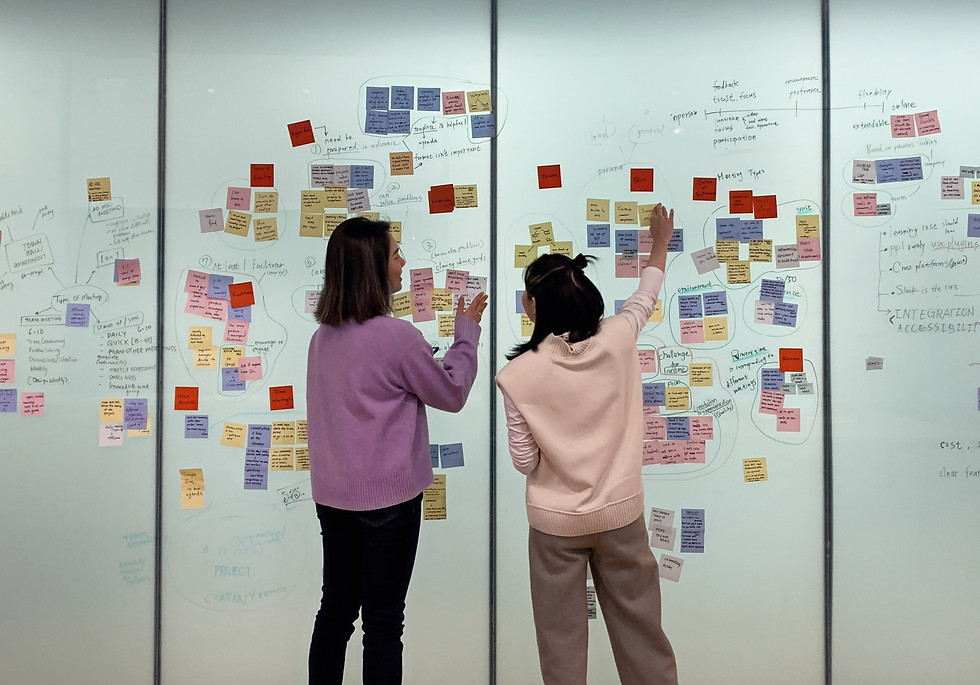
We began with desk research and unstructured 1:1 interviews, exploring remote work through social, technological, and economic lenses to uncover pain points and unmet needs.


Research analysis
Synthesis
We found that 98 million people in the U.S.—54% of the workforce—work remotely or in hybrid settings even after the pandemic, with flexibility cited as a top reason for job changes (McKinsey, 2022). Yet, 47% of leaders expressed concern about remote work's impact on team connection, citing relationship-building as the biggest challenge (Work Trend Index, 2022).
"It was much easier to develop relationships in person, you just hang out and talk about random stuff, and you bond with that person; that you can't really have over a zoom call"
"...you can't just walk over to your friend's table and quickly ask something..."
Our interviews echoed these concerns. Users described heightened stress, weakened interpersonal bonds, and a decline in motivation and growth. These findings made it clear: the problem wasn’t just meeting overload—it was the quality of human interaction. This insight prompted a pivotal shift in our focus.
reframed design statement
How might we foster casual interactions among remote employees to help companies rebuild their lost social capital and team culture?
Strategy/
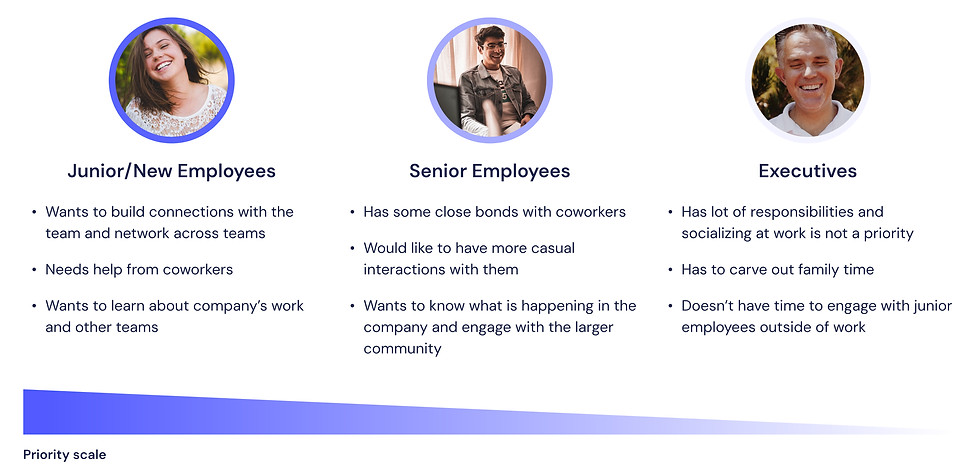
Defining our users: new and junior employees
We focused on new and junior employees as that user segment was most affected by the lack of social interactions while working remotely. They were seeking opportunities to connect with co-workers and grow in their career.
Unmet needs - design opportunities
Based on our research, we decided to prioritize the following user needs:
1. Provide opportunities for casual interactions
2. Helping junior and new employees connect with co-workers
These needs are unmet by many of the competitors (workplace meeting platforms), giving us an opportunity to create not just a desirable product, but also differentiate it in a competitive product landscape.

Product positioning

Product features
Design/
Concept and lo-fi prototype

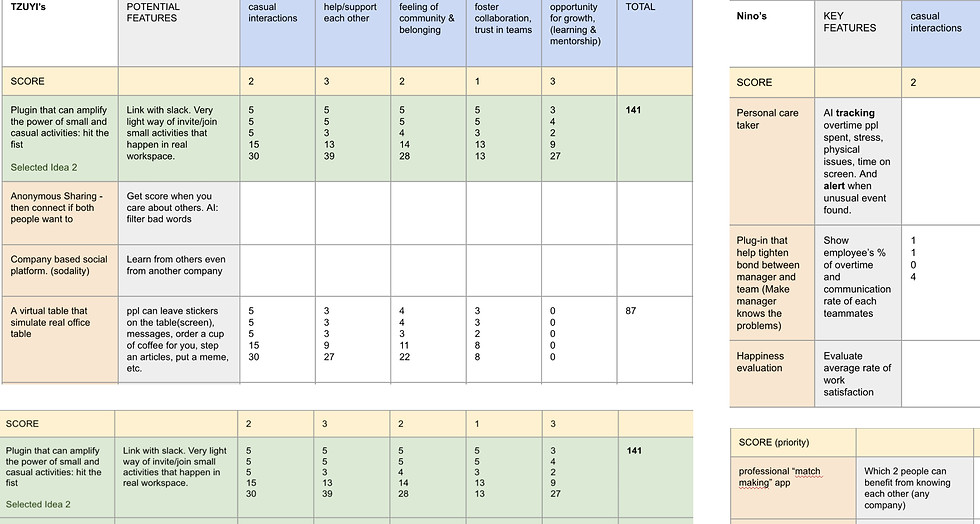
Concept ideation & desirability rating

Structuring & lo-fi prototype
User testing
Method: To validate our concept and early prototype, we conducted task-based usability tests. Participants were given contextual scenarios and asked to complete tasks such as joining chats, browsing events, and viewing profiles. As they interacted with the screens, we encouraged them to think aloud—sharing what they noticed, what actions they would take, and what they expected next.
Takeaways:
-
The landing page navigation felt unclear.
-
Users needed better cues about who was present in the space
-
Users expressed a strong desire for dedicated team spaces.
-
Uncovered important privacy preferences—participants were selective about what they were comfortable sharing publicly.
-
Notable interest in viewing job-related information that wasn’t easily available elsewhere.
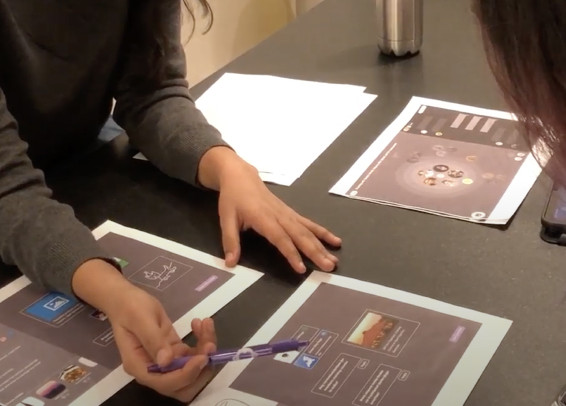
Multiple rounds of testing
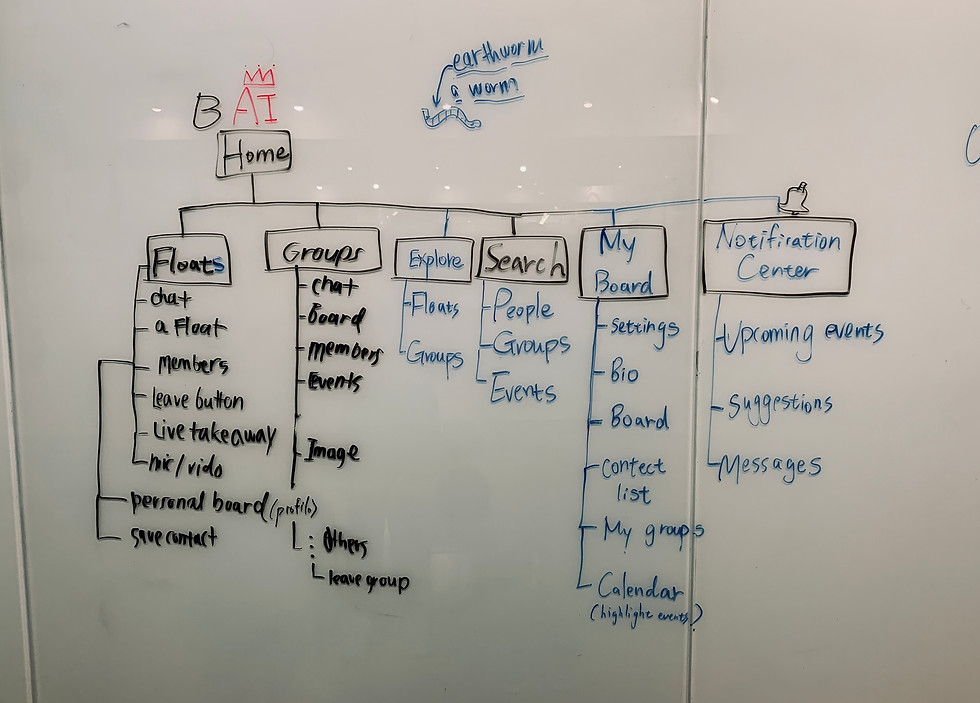
Iterating on the structure

Highlight: landing page user feedback
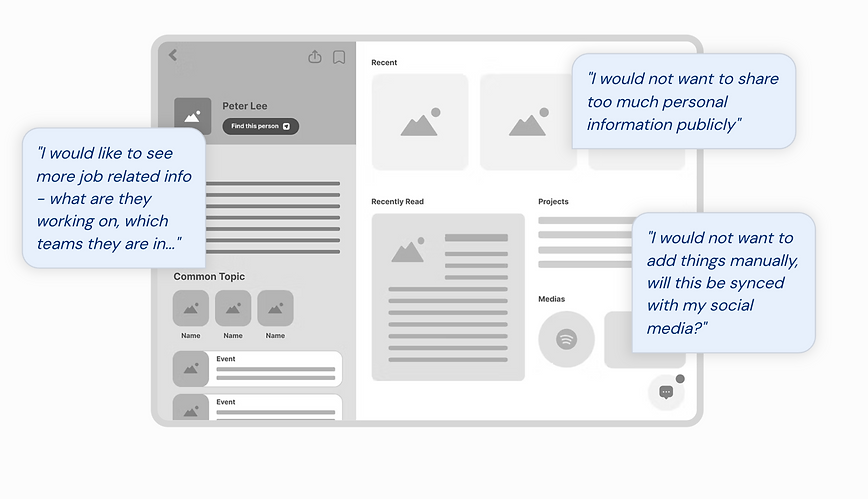
Highlight: profile page user feedback
Articulating key concepts
Insights from user testing helped us prioritize the most valued features and simplify the design for clarity and relevance. Before moving further with refining the design, we articulated the key concepts in words that helped align the team and clearly define the design decisions.


Final iteration: Float/
Float breaks away from the traditional UI design of meeting/chat platforms with a dynamic and playful interface. Our challenge was to introduce this new concept in an intuitive way. Here's some key features we designed based on our concept and testing:
1. Intuitive landing page
User testing revealed confusion around navigation labels like "Floats" and "Groups." To make the experience more intuitive, we renamed them to "Hall" and "Team"—terms users found more familiar and self-explanatory.
We added a feature to ask questions as many users said they imagined using this app to quickly seek help from co-workers.
Lastly, addressing users concerns about being distracted during work we added a Focus Mode feature that helps users intentionally silence distracting notifications.

Intuitive navigation on the landing page

Feature to ask questions
2. Conversational onboarding
As an innovative product, Float introduces unfamiliar concepts—like Floats, temporary chat groups that form when people “bump into” each other. To help users understand these new interactions, we designed a conversational onboarding experience that guides them step-by-step through key features in a friendly, interactive way. This approach not only builds familiarity but also mirrors the casual, social tone of the product.
3. Helping users feel in control
Following user testing, we made key updates to enhance clarity and ease of use. We added contextual cues to help users understand what each space represented and who could join their Float (temporary chat). Visual indicators now show when someone enters a conversation, making interactions feel more responsive and alive. We also introduced an option to make chats private, giving users more control over their interactions and comfort levels in social spaces.


Joining a float
4. Sparking connections
To rebuild the sense of community often missing in remote workplaces, Float enables lightweight, casual interactions that help employees connect beyond scheduled meetings.
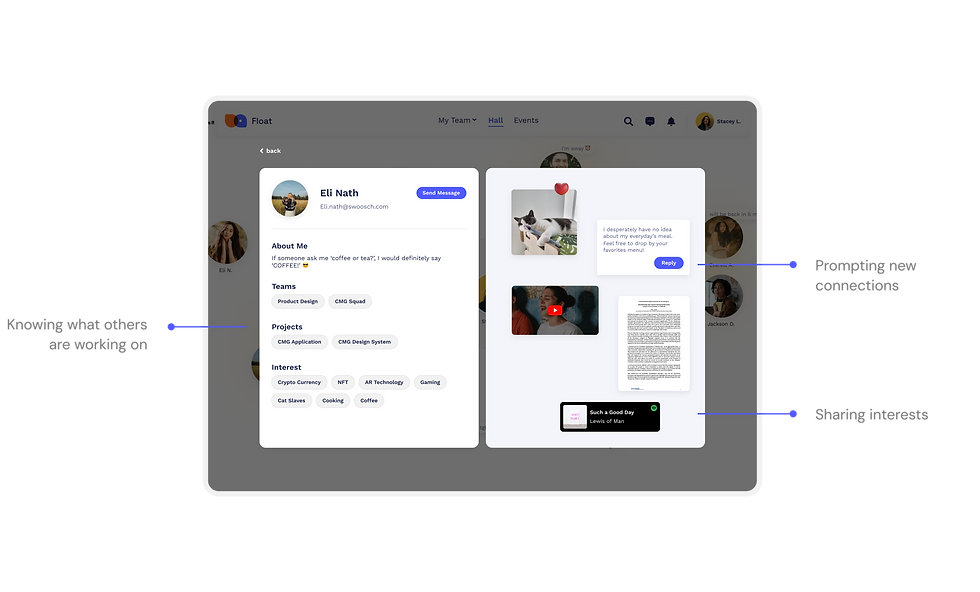
The profile page plays a key role—allowing users to discover coworkers, learn about their roles, interests, and what they’re working on. Users can also share photos, text updates, and other media publicly, creating low-pressure opportunities to spark conversation and build new connections around shared interests.
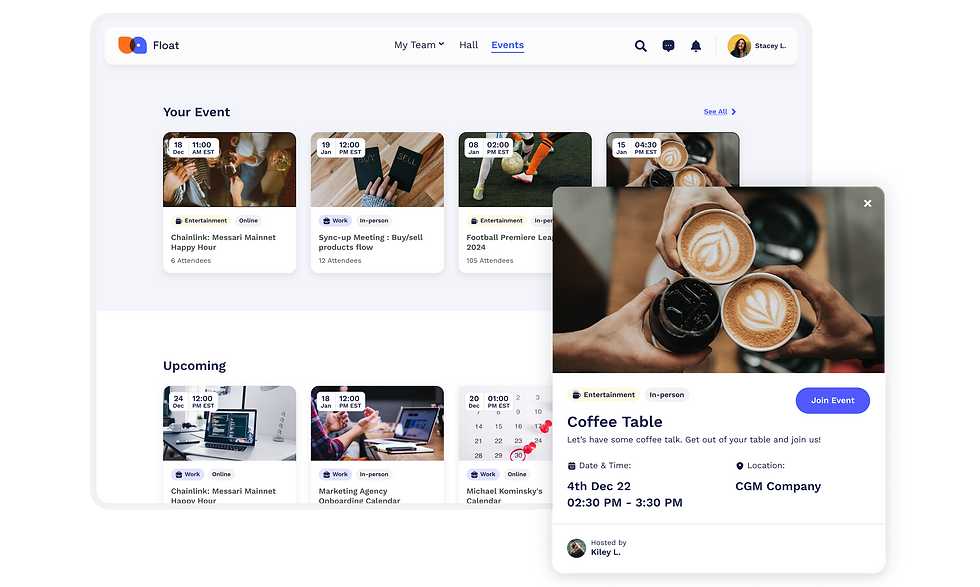
Float also makes it easy to organize and join events—another way for coworkers to connect beyond work. Whether it’s a virtual game night or a local meetup, events help foster team bonding in a more relaxed setting.
Profile page
Events page
Conclusion/
what we achieved
Winner: Strategic Design and Innovation Challenge
Our team won the 2nd place in the Strategic Innovation in Product & Service Design Program (Fall 2022), trailing the champion by 0.1 point.
Research contributions to Braid-It
Our team presented a methodical exploration of new product ideas for the start-up, contributing to their research and understanding of users.
learning and take-aways
Embracing ambiguity and a non-linear process
The process is filled with unexpected discoveries and turns making project planning overwhelming, this experience helped me learn to embrace the ambiguity. Instead of resisting it, I leaned into uncertainty, staying open to new directions and letting user insights guide the way forward.
Presenting unfinished work
One of the biggest personal learnings was getting comfortable with sharing unfinished work. Initially, presenting ongoing ideas to our sponsor during weekly check-ins felt uncomfortable. But as I took the lead in planning and facilitating these meetings, I began to appreciate the value of early feedback. I learned how to structure updates clearly, ask the right questions, and guide conversations toward actionable input—turning feedback sessions into collaborative design moments.